
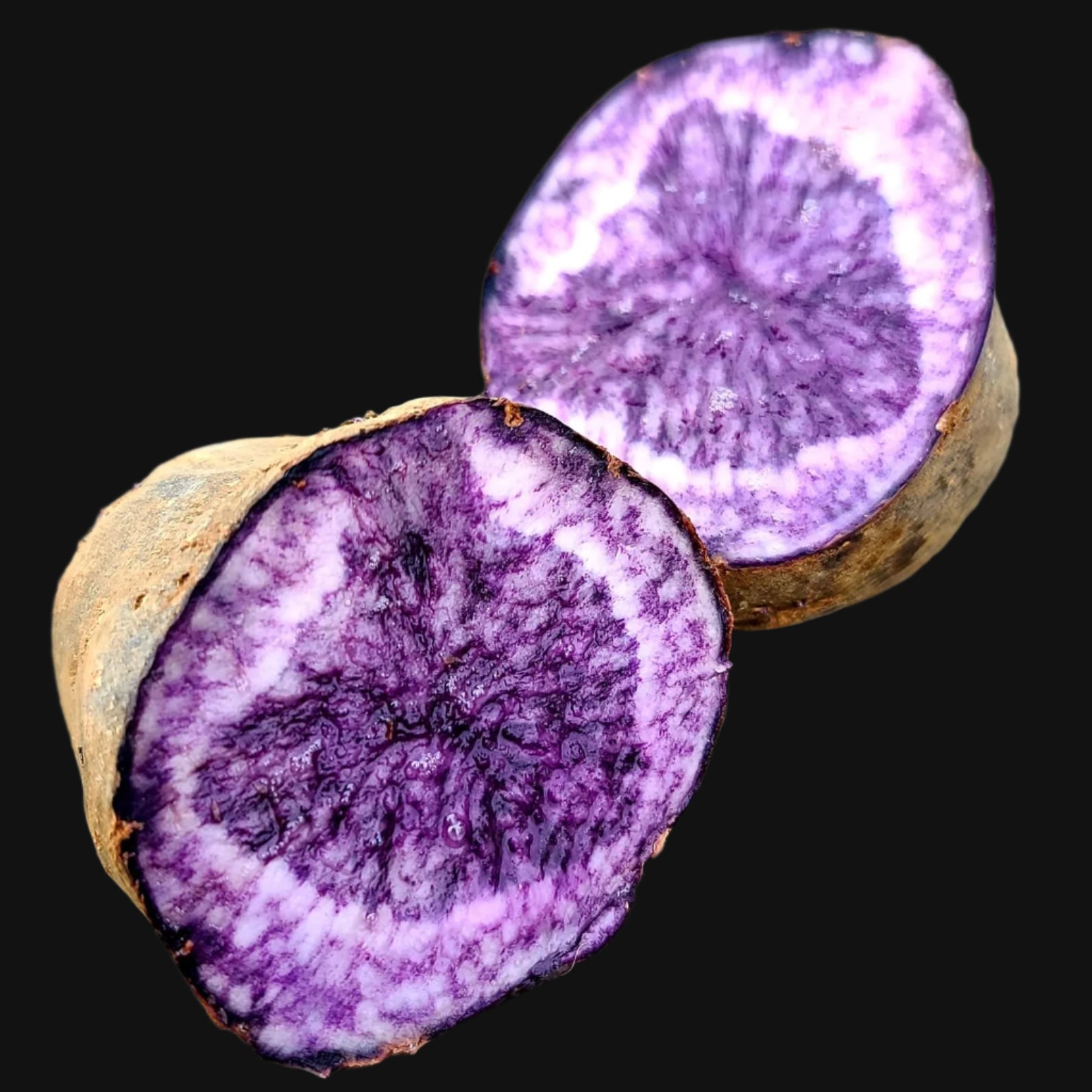
Mychosen Purple Seed Potatoes
Solanum Tuberosum

≈ 8-10 items | 450g (16.0oz)
Pre-Order Notice!
Growing Information
| Common Name | Mychosen Purple Seed Potatoes |
| Scientific Name | Solanum Tuberosum |
| Seed Count | 8-10 |
| Metric Weight | 450 g |
| Imperial Weight | 16.0 oz |
| Height | 1.2m (4ft) |
| Spread | 0.6-0.9m (2-3ft) |
| Canadian Zone Information | 4-9 |
| Growing Difficulty | Easy |
Product Reviews
Have a Question?
*Please add the product name to your question. We cannot see it.
Care Instructions
Seed Potatoes
If you receive your order in the fall or winter you will need to store your potatoes until spring.
Storage: Store potatoes in a cool (not freezing), dry, dark, and rodent-free place. Store in a breathable material like a paper bag or cardboard box to prevent condensation, which can lead to mould. Find an area with good air circulation that won’t dry your potatoes out completely. Check potatoes every 2-3 weeks and remove any that show signs of rot. Potatoes may become soft and wrinkly or sprout in storage. This is normal, simply handle these tubers with care.
Planting: Soil is ready for spring planting when the ground outside is about 7°C. Potatoes should be planted whole. Plant potatoes in holes 25-38cm (15-20in) apart and cover with 6-8cm (2-3in) of soil. A late frost after planting is okay as long as your potatoes are covered.
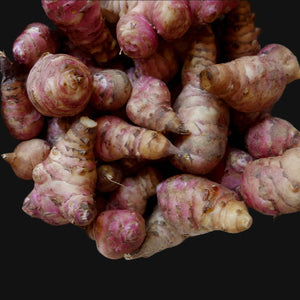
Jerusalem Artichokes
If you live in Coastal British Columbia, you can plant your tubers immediately upon receipt. Jerusalem artichokes are stored best in the ground as they can be frozen solid and still survive. *Small tubers included in your shipment have been added as bonus and can still be planted*
Storage: If you must store your tubers out of the garden, open the bag and place in the back of your fridge. Check the tubers inside every 2 weeks. If any show signs of mould, rinse them off, dry gentle, and return them to the bag ensuring they are fully covered in sawdust. Keep the sawdust lightly moistened only if you noticed it has become dry and the tubers start to wrinkle.
Planting: Plant tubers whole, 46 cm (18in) apart and 6cm (2in) deep. If your ground is already frozen, use a shovel to loosen the soil and dig a small hole. Thaw the soil you remove. Plant tubers as instructed and cover with the thawed soil to ensure tubers are covered completely with no air pockets.
Comfrey and Horseradish (Taproot Rootstock)
Storage: If you must store your roots out of the garden, open the bag for ventilation and store in the back of your fridge. Check roots every 2 weeks. If any show signs of mould, rinse them off, gently dry, and return them to the bag ensuring they are fully covered in sawdust. Lightly moisten the sawdust only if you notice it has become dry and the roots are shrivelling.
Planting: Your roots should be planted flat in unfrozen ground 60cm (2ft) apart and covered with 4cm (1in) of soil. Water in well. Roots can be planted in the winter if you live in Coastal British Columbia, cover with additional mulch to prevent the roots from freezing. Comfrey and horseradish will establish deep tap roots that will survive freezing in future years.
Dahlias
Dahlias are delicate and must be protected from freezing in all locations.
Storage: Upon receipt, store tubers in the bag (opened) in the back of your fridge or in a cool dark cupboard through the winter. Find a balance of good air circulation to prevent moulding without drying out the tubers. Dried dahlias will not sprout in the spring. Check on your dahlias every 2 weeks.
Planting: Plant your dahlias once danger of frosting has passed and the soil temperature has reached 15 degrees C. Plant your tubers flat with the eyes facing up. Cover with 5cm (2in) of soil and water in well. For earlier blooms, you can plant your tubers in a pot as instructed and store indoors or in a greenhouse until safe to plant outside.
Hardwood Cuttings
As you unpack your dormant cuttings you will notice one end is cut straight while the other is angled. This is to indicate the “up” and “down” ends of your cutting.
Storage: Ideally cutting should be planted immediately, but if you cannot, store them sealed in their bag in the back of the fridge.
Planting: Cuttings can be planted immediately upon receipt in coastal British Columbia. Push the angled end of your cutting ⅔ vertically into loosely worked soil amended with a small amount of compost. Water in well. – Cuttings can be started in their permanent location, but you may wish to first root your cuttings in a garden bed where they are easier to manage. Plant cuttings as instructed above spaced 15-20cm (6-8in) apart. Leave in your bed for the first year until rooted before transplanting them to their final location. If planting directly into your desired permanent location, ensure your cuttings receive adequate water in their first year and manage any nearby established plants so your cuttings do not become out-competed.
Nettles and Mints (Shallow Rootstock)
Storage: If you cannot plant immediately, open the bag for ventilation and store in the back of your fridge. Check roots every week and plant before they show any signs of mould.
Planting: In Coastal British Columbia, your rootstock can be planted upon receipt in a large planter pot, garden bed, or naturalized area. Nettles and mints appreciate rich, moist soil. Roots should be planted flat in loosely worked soil amended with compost. Plant with any sprouts facing upwards and any emerging roots down. Cover with 3-4cm (1in) of soil and water in well. Add a light mulch of leaves or other similar material to prevent roots from freezing solid. If planting in a naturalized area, clear other competing plants away from your roots so they receive adequate light to establish.
Organic Certification

We (a small farm) ship every week, on Wednesday!
Pick up available from our farm stand 542 Wootton Road, Metchosin
100% Canadian Grown in Metchosin, Vancouver Island, BC, Canada.
Processed-By-Hand
Certified Organic
Open Pollinated
Non-GMO
Frequently asked questions
Do you do sell at the farm?
No.
We do have a farmstand that is open during the season: March/April through to June/July
Will my order have tracking?
Maybe.
We ship all seed packages using Letter Mail through Canada Post.
However, if you order any Sprays, Bouquets, Root Stock, or Tubers; we automatically add protected shipping in a prepaid Canada Post box. These have a tracking number.
How much does shipping cost?
Save $20 when you spend $200
All our shipping fees include a handling fee
$7 Small Envelope
Orders 0g–7gup to 3 seed packages
$8 Medium Envelope
Orders 8g–15gup to 7 seed packages or ~ 1 Forager Pet Mix
$9 Large Envelope
Orders 16g–21gup to 10 seed packages and/or~ 1-2 Forager Pet Mix and/or rootstock/cutting
$13 Tiny Parcel
Orders 22g–44gup to 22 seed packages and/or~ 1-2 Forager Pet Mix and/or rootstock/cutting
$16 Extra Small Parcel
Orders 45g–135gSeed packages and/or~ 1-5 Forager Pet Mix/spray and/or rootstock/cutting
If you spend $200 this actually becomes free shipping with a $4 discount.
$19 Small Parcel
Orders 136g–500gSeed packages and/or ~ 1-5 Forager Pet Mix/spray and/or rootstock/cutting and/or 1 Tuber or JA
If you spend $200 this actually becomes free shipping with a $1 discount.
$22 Medium Parcel
Orders 501g–1400gSeed packages and/or ~ 1-5 Forager Pet Mix/spray and/or rootstock/cutting and/or 1-3 Tuber or JA
If you spend $200 this actually becomes $2.
$25 Large parcel
Orders 1401g–2500gSeed packages and/or ~ 1-5 Forager Pet Mix/spray and/or rootstock/cutting and/or 1-5 Tuber or JA
If you spend $200 this actually becomes $5.
$30 Extra Large Parcel
Orders 2501g and up
Anything your heart desires.
If you spend $200 this actually becomes $10.
What is your Customer Satisfaction policy?
We guarantee germination up to 75% on all our seeds in proper conditions.
That means we will replace them.
We make no guarantees on our Forager Pet products, other than that they are safe for the animals listed. But do reach out if your pet isn't happy.
Mistakes happen and can be fixed. So missing items, wrong items, or even damaged items can be replaced.
We will always work with you to find an appropriate solution.
How long does shipping take?
Letter Mail can take up to 5-6 weeks.
Parcels can take up to 1-2 weeks.
We ship Wednesdays which can also lead to delays.
Are all your products 100% Canadian?
Yes. All our products are grown in Metchosin BC or foraged from surrounding forests.
What is your refund policy?
We are a resolution first small business. That means we would love for you to be happy with our products.
However, if you want to return or refund, this can be done.