Back
Passer aux informations sur le produit
Horseradish

Raifort

Armoracia rusticana

À propos du raifort

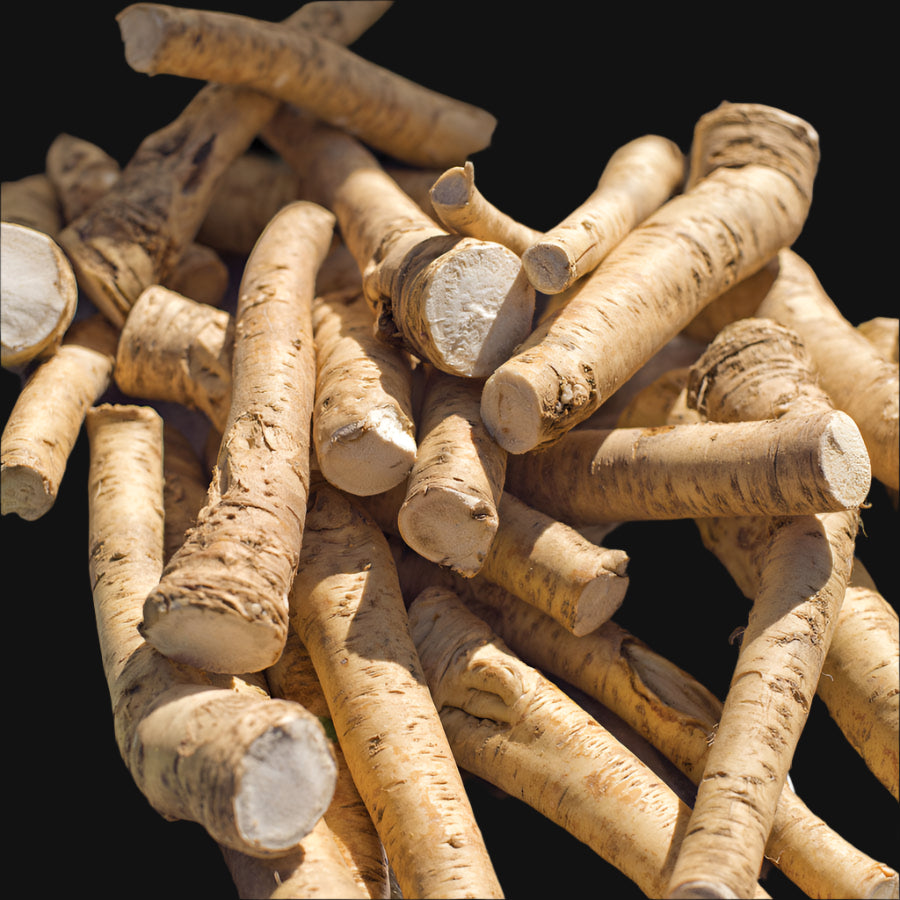
Le raifort ( Armoracia rusticana ) est une plante vivace rustique et vivace, réputée pour ses racines piquantes et savoureuses et sa présence remarquable dans les jardins. Pouvant atteindre 1,5 m de haut, le raifort présente de larges feuilles à nervures simples et produit de jolies fleurs blanches en été, ce qui en fait une plante à la fois fonctionnelle et ornementale.

La racine fraîche est parfaite pour préparer une sauce au raifort : il suffit de l'éplucher et de la râper, puis de la mélanger avec du vinaigre, de la crème et du sel marin à votre goût pour obtenir un condiment maison acidulé. Pour une croissance contrôlée, il est préférable de planter le raifort dans un grand pot, planté dans le jardin, afin d'empêcher ses longues racines de s'étendre.

Où peut-on cultiver du raifort

Le raifort pousse dans les zones 3 à 9, dans un sol riche et bien drainé, en plein soleil ou à mi-ombre. Il pousse bien en massif, en pot ou dans des espaces contrôlés pour limiter sa propagation.

Histoire et utilisations historiques

Originaire d'Europe, le raifort est cultivé depuis des siècles à des fins culinaires et médicinales. Sa saveur piquante et acidulée en faisait un ingrédient de base des condiments traditionnels, tandis que ses racines étaient utilisées dans des remèdes pour la santé respiratoire et digestive. Aujourd'hui encore, le raifort reste un ingrédient populaire dans les jardins comme dans les cuisines.

Informations sur la zone canadienne

  • Zones 8-9 : Plantez les racines au début du printemps ou en automne pour une croissance vigoureuse.
  • Zones 5-7 : Plantez au printemps après le dégel du sol ou au début de l'automne pour l'hivernage.
  • Zones 3-4 : Paillez abondamment après la plantation pour protéger les racines des températures glaciales.


Comment cultiver et récolter le raifort

  1. Plantation : Plantez les racines verticalement ou légèrement en biais, en laissant les racines à 5 à 10 cm (2 à 4 po) sous la surface du sol. Utilisez un grand pot ou enfoncez un récipient dans le jardin pour lutter contre la maladie.
  2. Arrosage : Gardez le sol constamment humide mais pas gorgé d'eau pendant la saison de croissance.
  3. Récolte : Récoltez les racines à la fin de l’automne ou au début de l’hiver, après les premières gelées, lorsque leur saveur est la plus intense. Creusez soigneusement pour éviter de casser les longues racines.
  4. Replantation : Conservez une partie de la racine récoltée pour propager de nouvelles plantes l'année suivante.

Conseils pour conserver les semences en vue d'un approvisionnement futur

Le raifort se multiplie principalement par bouturage plutôt que par graines. Cependant, si vous souhaitez conserver vos graines :

  1. Laisser fleurir et semer : Laissez les plantes fleurir en été, produisant des gousses de graines après la pollinisation.
  2. Récoltez les graines : une fois que les gousses sont sèches et brunes, coupez-les de la plante et placez-les dans un sac en papier.
  3. Sécher et nettoyer : Laisser sécher les gousses 1 à 2 semaines, puis les écraser pour en extraire les graines. Séparer les graines de la balle.
  4. Conservation : Conserver les graines dans un récipient hermétique, dans un endroit frais et sombre. Bien conservées, elles restent viables jusqu’à deux ans.

Certifié biologique par

Association des producteurs biologiques des îles (certificat n° 1962)

≈ 2-5 items | 65g (2.29oz)

$15.00 CAD
Out of Stock
Hit Join the Waitlist to be notified as soon as we restock.

Pre-Order Notice!

Items on pre-order will be delayed. The rest of your order will ship as normal.
Unless you live in coastal BC, all pre-orders (except Jerusalem artichoke alone) ship March 2026
Growing Information
Common Name Raifort
Scientific Name Armoracia rusticana
Seed Count 2-5
Metric Weight 65 g
Imperial Weight 2.29 oz
Height 1,2 à 1,5 m (4 à 5 pieds)
Spread 0,6 à 1 m (2 à 3 pieds)
Canadian Zone Information 3-9
Growing Difficulty Facile
Product Reviews
Have a Question?

*Please add the product name to your question. We cannot see it.

Care Instructions

Seed Potatoes

If you receive your order in the fall or winter you will need to store your potatoes until spring. 

Storage: Store potatoes in a cool (not freezing), dry, dark, and rodent-free place. Store in a breathable material like a paper bag or cardboard box to prevent condensation, which can lead to mould. Find an area with good air circulation that won’t dry your potatoes out completely. Check potatoes every 2-3 weeks and remove any that show signs of rot. Potatoes may become soft and wrinkly or sprout in storage. This is normal, simply handle these tubers with care.

Planting: Soil is ready for spring planting when the ground outside is about 7°C. Potatoes should be planted whole. Plant potatoes in holes 25-38cm (15-20in) apart and cover with 6-8cm (2-3in) of soil. A late frost after planting is okay as long as your potatoes are covered. 

Jerusalem Artichokes

If you live in Coastal British Columbia, you can plant your tubers immediately upon receipt. Jerusalem artichokes are stored best in the ground as they can be frozen solid and still survive. *Small tubers included in your shipment have been added as bonus and can still be planted*

Storage: If you must store your tubers out of the garden, open the bag and place in the back of your fridge. Check the tubers inside every 2 weeks. If any show signs of mould, rinse them off, dry gentle, and return them to the bag ensuring they are fully covered in sawdust. Keep the sawdust lightly moistened only if you noticed it has become dry and the tubers start to wrinkle.

Planting: Plant tubers whole, 46 cm (18in) apart and 6cm (2in) deep. If your ground is already frozen, use a shovel to loosen the soil and dig a small hole. Thaw the soil you remove. Plant tubers as instructed and cover with the thawed soil to ensure tubers are covered completely with no air pockets.  

Comfrey and Horseradish (Taproot Rootstock)

Storage: 
If you must store your roots out of the garden, open the bag for ventilation and store in the back of your fridge. Check roots every 2 weeks. If any show signs of mould, rinse them off, gently dry, and return them to the bag ensuring they are fully covered in sawdust. Lightly moisten the sawdust only if you notice it has become dry and the roots are shrivelling. 

Planting: Your roots should be planted flat in unfrozen ground 60cm (2ft) apart and covered with 4cm (1in) of soil. Water in well. Roots can be planted in the winter if you live in Coastal British Columbia, cover with additional mulch to prevent the roots from freezing. Comfrey and horseradish will establish deep tap roots that will survive freezing in future years.

Dahlias

Dahlias are delicate and must be protected from freezing in all locations.

Storage: Upon receipt, store tubers in the bag (opened) in the back of your fridge or in a cool dark cupboard through the winter. Find a balance of good air circulation to prevent moulding without drying out the tubers. Dried dahlias will not sprout in the spring. Check on your dahlias every 2 weeks.

Planting: Plant your dahlias once danger of frosting has passed and the soil temperature has reached 15 degrees C. Plant your tubers flat with the eyes facing up. Cover with 5cm (2in) of soil and water in well. For earlier blooms, you can plant your tubers in a pot as instructed and store indoors or in a greenhouse until safe to plant outside. 

Hardwood Cuttings 

As you unpack your dormant cuttings you will notice one end is cut straight while the other is angled. This is to indicate the “up” and “down” ends of your cutting.

Storage: Ideally cutting should be planted immediately, but if you cannot, store them sealed in their bag in the back of the fridge.

Planting: Cuttings can be planted immediately upon receipt in coastal British Columbia. Push the angled end of your cutting ⅔ vertically into loosely worked soil amended with a small amount of compost. Water in well. – Cuttings can be started in their permanent location, but you may wish to first root your cuttings in a garden bed where they are easier to manage. Plant cuttings as instructed above spaced 15-20cm (6-8in) apart. Leave in your bed for the first year until rooted before transplanting them to their final location. If planting directly into your desired permanent location, ensure your cuttings receive adequate water in their first year and manage any nearby established plants so your cuttings do not become out-competed. 

Nettles and Mints (Shallow Rootstock)

Storage: If you cannot plant immediately, open the bag for ventilation and store in the back of your fridge. Check roots every week and plant before they show any signs of mould.

Planting: In Coastal British Columbia, your rootstock can be planted upon receipt in a large planter pot, garden bed, or naturalized area. Nettles and mints appreciate rich, moist soil. Roots should be planted flat in loosely worked soil amended with compost. Plant with any sprouts facing upwards and any emerging roots down. Cover with 3-4cm (1in) of soil and water in well. Add a light mulch of leaves or other similar material to prevent roots from freezing solid. If planting in a naturalized area, clear other competing plants away from your roots so they receive adequate light to establish.

Organic Certification

We (a small farm) ship every week, on Wednesday!

Pick up available from our farm stand 542 Wootton Road, Metchosin

100% Canadian Grown in Metchosin, Vancouver Island, BC, Canada.

Processed-By-Hand

Certified Organic

Open Pollinated

Non-GMO

Frequently asked questions

Do you do sell at the farm?

No.

We do have a farmstand that is open during the season: March/April through to June/July

Will my order have tracking?

Maybe.

We ship all seed packages using Letter Mail through Canada Post.

However, if you order any Sprays, Bouquets, Root Stock, or Tubers; we automatically add protected shipping in a prepaid Canada Post box. These have a tracking number.

How much does shipping cost?

Save $20 when you spend $200

All our shipping fees include a handling fee

$7 Small Envelope 

Orders 0g–7gup to 3 seed packages

$8 Medium Envelope

Orders 8g–15gup to 7 seed packages or ~ 1 Forager Pet Mix

$9 Large Envelope

Orders 16g–21gup to 10 seed packages and/or~ 1-2 Forager Pet Mix and/or rootstock/cutting

$13 Tiny Parcel

Orders 22g–44gup to 22 seed packages and/or~ 1-2 Forager Pet Mix and/or rootstock/cutting

$16 Extra Small Parcel

Orders 45g–135gSeed packages and/or~ 1-5 Forager Pet Mix/spray and/or rootstock/cutting

If you spend $200 this actually becomes free shipping with a $4 discount.

$19 Small Parcel

Orders 136g–500gSeed packages and/or ~ 1-5 Forager Pet Mix/spray and/or rootstock/cutting and/or 1 Tuber or JA

If you spend $200 this actually becomes free shipping with a $1 discount.

$22 Medium Parcel

Orders 501g–1400gSeed packages and/or ~ 1-5 Forager Pet Mix/spray and/or rootstock/cutting and/or 1-3 Tuber or JA

If you spend $200 this actually becomes $2.

$25 Large parcel

Orders 1401g–2500gSeed packages and/or ~ 1-5 Forager Pet Mix/spray and/or rootstock/cutting and/or 1-5 Tuber or JA

If you spend $200 this actually becomes $5.

$30 Extra Large Parcel

Orders 2501g and up

Anything your heart desires.

If you spend $200 this actually becomes $10.

What is your Customer Satisfaction policy?

We guarantee germination up to 75% on all our seeds in proper conditions.

That means we will replace them.

We make no guarantees on our Forager Pet products, other than that they are safe for the animals listed. But do reach out if your pet isn't happy.

Mistakes happen and can be fixed. So missing items, wrong items, or even damaged items can be replaced.

We will always work with you to find an appropriate solution.

Customer Satisfaction Policy

How long does shipping take?

Letter Mail can take up to 5-6 weeks.

Parcels can take up to 1-2 weeks.

We ship Wednesdays which can also lead to delays.

Are all your products 100% Canadian?

Yes. All our products are grown in Metchosin BC or foraged from surrounding forests.

What is your refund policy?

We are a resolution first small business. That means we would love for you to be happy with our products.

However, if you want to return or refund, this can be done.

You May Also Like